What I learned this week: Stats that matter

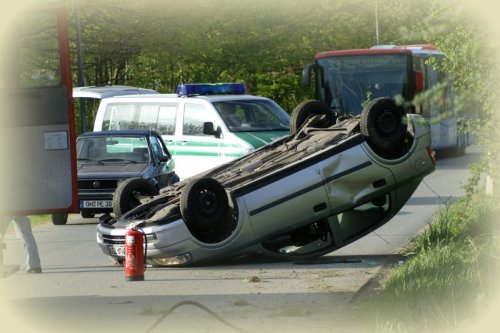
car accident

Like most bloggers, I spend an inordinate amount of time considering the stats related to Grandma's Briefs — how many comments, unique visitors, page views, followers, friends, so on and so forth. Such stats matter greatly to me as a blogger.

This week I learned all kinds of other stats that matter greatly to me as a grandmother, mother, wife, daughter — someone with too much to lose to not take notice, not be concerned, not share with others what I've learned.

Here is just a smidgen of wide-ranging and crucial stats I gleaned from the Lifesavers 2013 National Conference on Highway Safety Priorities, in hopes that you, too, will take notice, be concerned and share with others:

• In the United States, we drive, as a whole, 3 trillion miles per year.

• 35,000 people die because of car crashes each year. (It's the leading cause of accidental death.)

• You're four times more likely to crash when using a cell phone while driving, whether hands-free phone or not.

• Twenty-five percent of all crashes involve cell phones (talking or texting).

• There's a 23 times greater crash risk when texting while driving.

• There were 2.3 trillion text messages sent in 2011.

• Forty-nine percent of adults text while driving.

• Seventy-seven percent of teens report they have seen their parents text and drive.

• Forty-three percent of teens admit to texting while driving.

• Seventy-five percent of teen fatal crashes do not involve alcohol. 

• A sudden stop at 30 miles per hour could cause the same crushing force on a child's brain and body as a fall from a three-story building (which is why buckling up kids is so important).

• Most children need to use a booster seat until age 10-12 for maximum protection and improved comfort in the car.

• Each year, 325,000 Americans are injured in drunk driving crashes (one every two minutes), and drunk driving kills 10,000 Americans each year.

• One in five 16-year-old drivers experience a collision in their first year of driving.

• Seniors are outliving their ability to drive safely by an average 7 to 10 years, depending on gender.

• Car crashes are the leading cause of death for ages 5 to 24.

• With the exception of teenagers, seniors have the highest crash death rate per mile driven, due to age-related fragility.

• In crashes caused by vehicle maintenance factors, 90 percent can be attributed to improperly inflated tires.

Yes, the stats are frightening. But all of that — plus a whole lot more — is what I learned this week.

Disclosure: My attendance at the Lifesavers Conference was fully sponsored by Toyota Collaborative Safety Research Center.

photo: stock.xchng

Today's question:

What did you learn this week?
10 reasons this grandma needs new glasses

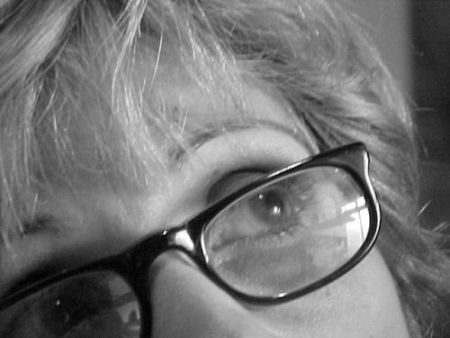
woman wearing glasses

Yesterday morning I attempted to eat yet another Dove foil-wrapped chocolate egg left over from Easter — solely for the purpose of getting in my recommended daily allowance of dark chocolate, for the touted health benefits. (We'll ignore that the egg was milk chocolate, not dark.)

But I couldn't. I simply could not eat another chocolate egg. Literally — because I could not see the spot in the foil where I could begin to unwrap the darn thing so I could pop it into my mouth.

After cursing the foil for foiling my attempt to pack in a few more unnecessary calories, I decided to put on my reading glasses and give it another shot.

Voilà! I had the chocolate unwrapped and in my mouth in no time... quickly followed by two more easily unwrapped eggs. (Hey, don't judge; that was only half the suggested serving size.)

In the past few years, it's become increasingly difficult to do anything that requires me to see anything smaller than, oh, a golf ball. Like finding where the foil on a chocolate egg can best be opened. Lately, though, it's no longer just difficult, it's now downright impossible.

The time has come for me to invest in a new pair of bifocals to replace my once-not-so-necessary yet now so very expired pair. It's become a necessary evil, so I can be fully bespectacled and prepared for any less-than-golf-ball-sized matters that might come my way — without having to wear my reading glasses around my neck on a chain or readily available atop my head at all times.

I've come to this conclusion because the unfoiling of the chocolate eggs is just one minor example of everyday tasks I once did with ease that now require glasses. Here are nine more:

Reason No. 9: Seeing my wrinkles and brown spots. I thought my new face cream was doing surprisingly well, as my wrinkles were disappearing, my brown spots fading. Or so I thought — until I put on my reading glasses the other day to tweeze my brows (and, yes, chin hairs). Oh my! Nope, that to-remain-unnamed face cream definitely isn't working as well as I thought it was.

Reason No. 8: Seeing the time on my iPhone when driving.

Reason No. 7: Seeing who I'm trying to call — or who is calling me — when I'm driving. (Forget texting when driving... and not just because it's illegal.)

Reason No. 6: Reading the packages and price tags — or even my list — when shopping.

Reason No. 5: Choosing music on my iPod.

Reason No. 4: Choosing camera settings on my camera.

Reason No. 3: Picking and choosing what morsel to savor next from my salad. Or from any meal at any time.

Reason No. 2: Reading recipes — even those I've been making for years. (My memory has gotten nearly as bad as my vision.)

And the NUMBER ONE reason why this grandma needs new glasses: So I can see my grandsons when visiting through Facetime on the iPhone!

At this point, when connecting via Facetime without glasses — or even with my reading glasses, since it's all blurred when I have to hold the phone far enough away so they can see me — it's nearly impossible to tell if Bubby and Mac are as happy to see me as I am them. Well, as happy as I am to sort of see them.

I suppose that final reason could have been the first... and the last... and the only one mentioned. For that surely would have been enough.

Whether one reason or ten, though, there's no longer any reasonable doubt: This grandma needs new glasses.

Case closed.

photo: stock.xchng

Today's question:

What activities have recently frustrated you because of less-than-stellar vision?

The flu and what I didn't do

I have a tendency to think rules and statistics don't apply to me. Not because I consider myself above others, but simply because I prefer to be an optimist and assume good things will happen, not bad.

Most times such positive thinking yields benefits. Recently, though, such positive thinking left me laid up and sick as a dog.

(Quick aside: As I pet my dogs yesterday morning while in my sickly state, I pondered that phrase, as my dogs are never sick. The phrase makes no sense.)

Anyway, what happened is this: For quite some time, I had it on my calendar to go visit Bubby and Mac at the end of January. Then, days before my visit, Bubby was confirmed as having the flu, and it was highly likely Mac would come down with it, too. The question arose regarding if I should cancel the trip, considering my MS and what exposure to the flu might do.

I chose to visit them anyway. I assured my daughter—their mother—there was no need to worry because I'd be just fine. And when Mac avoided the flu but came down with bronchiolitis during my visit, I again assured my daughter I'd be just fine.

And I was fine—while I was there. The day after I returned home, though, the super bugs from those little boys settled in, leaving me, well, sick as a dog.

So yesterday, in my sick-as-a-dog state, what did I do? Well, of all the things I should have done, here is what I didn't do:

• I didn't walk my dogs.

• I didn't write the book reviews I need to write.

• I didn't comment on the blogs I should have.

• I didn't complete three articles I was on deadline to write.

• I didn't shower until 4 p.m. (Though I did brush my teeth.)

• I didn't put on makeup nor do my hair after that shower.

• I didn't email sources for an article I need to write.

• I didn't respond to the gazillion emails I should have responded to.

• I didn't write the half-gazillion emails I should have written.

• I didn't read.

• I didn't write.

• I didn't even listen to any music.

What did I do?

I sat on the couch, wrapped up in an afghan with one of my cats, each of my (non-sick) dogs on their beds nearby and watched episode after episode of Downton Abbey—a show whose spell I didn't think I'd fall under but figured I'd see what all the hoopla is about.

What did I learn?

I learned that the rules and statistics do apply to me. Especially when it comes to catching the flu. Doubly that when it comes to being charmed by Downton Abbey.

(Though I've yet to learn why 'sick as a dog' is an acceptable phrase.)

photo: Marin-FreeDigitalPhotos.net

Today's question:

When were you last sick as a dog?

Photo replay: Breathing easy ... sort of

Mac was prescribed several days of breathing treatments for his bronchiolitis, diagnosed during my visit last week. Here he has his first treatment, giving Mommy the thumbs up that he's doing okay with "Dino," the breathing mask. Only thing: Sweet guy's not yet got the thumbs-up gesture figured out.

Enjoy your Sunday.

Musings on eating, with two hands

If not for that well-placed comma in today's post title, you just might think what follows will be all about double-fisted dining. That's not it at all. Today I'm spouting recent thoughts I've had on the contradictions related to kids and how they eat. Or don't eat.

On one hand (this is the "two hands" part), we all know about, are concerned about the frightening statistics on childhood obesity today. The issue tops the list of those addressed by our first lady, health and welfare organizations, doctors, school lunch programs. Most importantly, it's something on the minds of many a parent and grandparent.

We all want our kiddos to eat less, move more, be in better shape overall. Privately as well as publicly, we show concern that kids are exercising too little, eating too much.

That's on one hand.

On the other hand, always on the minds of mothers and grandmothers, more so than anyone, is how the heck to get our little ones to eat. Especially when it comes to toddlers. They don't seem to eat when we want them to or what we want them to.

In direct contrast to the obesity issue, there's the continual concern on the part of many a frazzled parent or grandparent that a child isn't getting enough food. There are books, magazines, websites, television programs dedicated to helping figure out how to get some food into the mouths and tummies of those tiny tots so they can grow up big and strong.

We beg, plead, cajole, bribe, sometimes even punish, all in the name of getting Junior to eat. I'm not talking about just veggies and other healthy foods. If you regularly enjoy the company of a child under the age of five, you likely know what I mean.

My oldest grandson is the very pickiest of the pickiest kids I have ever met. That darn kid doesn't like pudding...or whipped cream...or jello. He doesn't like jelly on his peanut butter sandwiches. He refuses to eat cheese quesadillas if the brown spots on the tortilla are noticeable. And he has never, ever had a hamburger—not even as part of a McDonald's Happy Mealin. Not in his entire life. Seriously. "I don't like them" is his response when asked why. How he knows that is your guess as good as mine, since he's never had so much a nibble of a burger.

Yet he does like avocados, broccoli, salmon. A kid can't live on those things alone, though. Well, they probably could...maybe...but that's not being realistic. So his mom and dad (and grandma and other caregivers, at times) spend inordinate amounts of time and energy trying to get the kid to eat. Anything. I used to think Megan was making it up. Then I spent extended time with Bubby and came away wondering—still wonder—how he manages to stay alive much less thrive.

Then there's his brother. My youngest grandson. My Mac. The happiest little eater ever. Mac dives right in, willing to experience all things edible—plus things non-edible at times, too. He even dipped into the salsa dish just like the big boys when we recently visited a Mexican restaurant. Sure, he once famously sneered and snarled at strawberries, but he gobbled them right up the very next day, so those Grandma served up just must have seemed exceptionally tart to him.

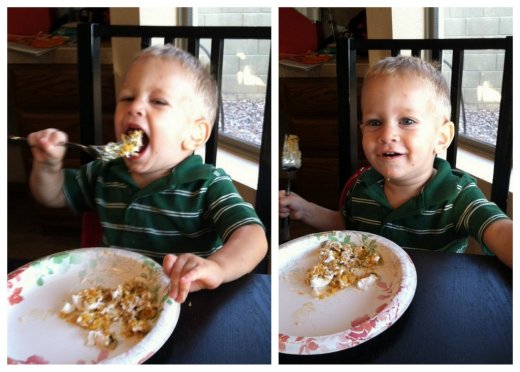
Mac enjoys food, enjoys eating. Nearly anything. Megan sent me the following photos the other night of Mac happily trying out a new recipe she had cooked up.


Bubby greets Mommy's new recipes with disdain; Mac delights in them, requires a big fork to to satisfy his big appetite.

On one hand there's Bubby, who refuses to eat. On the other hand there's Mac, who eats anything and everything.

On one hand there's the problem of childhood obesity and the need to get kids to eat less and better. On the other hand there's the frustration and desperation many parents face in trying to get their kids to eat anything at all.

Parenting can be a challenge, and never more so—nor more conflict-ridden—than when it comes to kids and food. The getting them to eat, but not eat too much.

Just one more reason I'm glad I'm Grandma to little ones, not Mom. I get to muse; Megan/Mom gets to wring her hands while trying to figure out how to make her kids eat—just not too much.

Today's question:

What has been your bigger challenge as a parent or grandparent: Getting kids to eat less and more healthy or getting them to eat anything at all?

I would do anything for love (but I won't do that)

Remember the old Meatloaf song, the over-the-top and emotionally draining "I Would Do Anything For Love (but I won't do that)." If not, feel free to take a moment and refresh your memory here.

That song has run through my head several times in the past few weeks, in response to recent news reports. For when it comes to my family and friends—my daughters in particular, in this instance—I sincerely would do anything for love. Whatever that anything may be, whether time, money, attention, affection, I will do and give to the full extent I'm able.

But, as that earworm of a song says, I won't do that. That being what some incredible and amazing mothers—grandmothers, really—have recently made the news for doing.

SO BLESSED MY GRANDSONS CAME NATURALLY.You may recall the many stories online and off about the kind and courageous—and physically fit, I must add—grandmother who served as a surrogate for her infertile daughter. The daughter was repeatedly unsuccessful in carrying a child to term, so the sixty-one-year-old mother, who had gone through menopause ten years prior, agreed to hormone supplementation and in vitro fertilization of her daughter's egg and her son-in-law's sperm. She successfully carried to term and in August, delivered via Cesarean section her daughter's biological daughter. Her own grandchild.

What an amazing gift to give a beloved daughter. And this most recent woman is not alone, as such surrogacies have taken place countless times in the past.

I truly, madly, deeply love my three daughters. But I don't think I'm selfless enough to commit to being a surrogate for any of them.

Serving as a surrogate isn't the most recent act of selflessness on the part of a mother, a grandmother-to-be, that has made the news. Yesterday's newspaper (yes, I read the actual print paper) featured a story abouttwo Swedish women who underwent the world's first mother-to-daughter uterus transplants, in hopes they will be successful in getting pregnant and giving birth. That's two daughters with two mothers who gave up their uteruses (uteri?) for the love of their child. One daughter had her uterus removed because of cancer, the other was born without a uterus. Now, thanks to their moms, they each have one. Now the quest to bear children is on.

I honestly cannot imagine the point of desperation one must reach in order to consider, much less do such a thing. Such a heartbreaking state it must be. Regardless, if any one of my daughters came to me entertaining such a thought, suggesting such a plan, I couldn't do it. I really am not that strong, not that selfless.

And I really am not so committed to becoming a grandma that I'd birth my own grandchildren.

Although, I already am a grandma, so I can't say for sure.

I'm not judging any of the grandmothers who sacrifice in such a way, I promise. I truly think they are incredibly loving, giving women who have gone above and beyond the call of duty of a mother, of a grandmother. I'm just trying to understand the degree of cojones it takes. And why I don't have them, what I'm lacking that makes me, as a mother, unwilling to do such a thing for my own daughters, if need be.

In all honesty, because of various health issues, I'm pretty darn sure I would not be physically able to be a surrogate or offer up my uterus to be transplanted into my daughter. My oldest happened to be visiting as I wrote this, and I asked her if she'd ever consider requesting I be her surrogate or uterus donor. Her immediate response was "no," because of what the health repercussions may be to me, her mother.

I admit to being a wee bit thankful for those health issues that make me a poor candidate. They save me from having to find out for sure how deep is my love, for my girls, for my future grandchildren. At least when it comes to doing that. Because—more honesty here—I can't be one-hundred-percent certain that I wouldn't do such a thing, if it would make all the difference in a daughter's world if I did.

I pray my girls never reach the point of such desperation for children that surrogacy and transplants requiring my participation are a consideration. For any of us.

When it comes to my daughters, I really, truly, honestly would do anything for love.

But I won't do that.

I don't think.

And I hope I never have to find out for sure.

(Photography by Alison Baum. Full stories on the women mentioned can be found here and here.)

Today's question:

How about you? Would you do that?

Brusha, brusha, brusha

I receive hundreds of press releases in my Grandma's Briefs mailbox each week. I get lots of info on lots of things: good things, scary things, important things, fun things, nifty-gadgety things. And more often than you might think, bizarro things that make me wonder why in the world the PR folks thought I'd appreciate such information.

One of the recent scary-but-important things I received was a press release relaying the information that, according to top U.S. dental associations, the United States is experiencing a resurgence in childhood tooth decay. An especially interesting stat was that dental disease is now the top chronic health problem for children, per the Centers for Disease Control and Prevention.

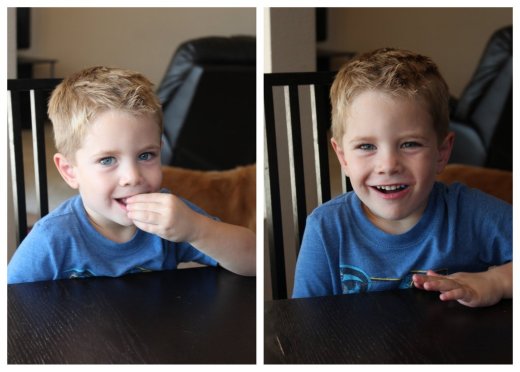
BUBBY'S FIRST DENTIST VISITThe news made me thankful Bubby recently had his first dental visit, where he, his pearly whites, and his teeth-brushing techniques were given an A for effort.

Part of the reason dental disease is such a problem nowadays, according to the information, lies in the fact many parents don’t think baby teeth are important, as they’ll be replaced by a child’s permanent teeth. Also, some pediatricians—my grandsons’ included—typically recommend a child first visit the dentist at three years of age. Dental associations, though, have recently updated their recommendation for dentist visits, saying it should happen once the very first tooth erupts.

Which means Bubby, at four years old and with a mouthful of teeth, was way late in getting to the dentist. And that even Mac, at 13 months but well on his way to a full mouth, needs to get in the dentist's chair pronto.

Dental care is a parent's duty, not a grandparent's. In light of the stats and the updated info, though, here are a few ways grandparents can help promote good brushing habits and cavity prevention in their grandchildren:

• Encourage parents (without overstepping your boundaries, of course) to take the kiddos to the dentist as soon as that first tooth is celebrated.

• Be sure grandchildren brush morning and night when staying at your house. Have fun (and spare) toothbrushes on hand, as well as flavored toothpastes that appeal to the little ones. Perhaps make a game of it and brush together. Also, be sure to supervise the older ones and do the actual brushing for little ones.

• When seeking small gift ideas, consider giving new toothbrushes and toothpastes featuring a child’s favorite characters. Or maybe a battery powered one, if a grandchild doesn’t have one at home.

• Limit candy, soda, and sweet treats that aren’t good for teeth.

• Same goes for fast food and processed foods, which are typically high in sugar.

• Never share eating utensils with children as that can transfer cavity-producing bacteria from your mouth to theirs.

• Keep on the lookout for tooth decay and halitosis (bad breath). If noticed, mention it—again, tactfully—to Mom or Dad.

• Read books together that focus on good dental habits. Consider ABC Dentist: Healthy Teeth from A to Z by Harriet Ziefert as well as the numerous books in which favorite characters—Dora the Explorer, Berenstain Bears, Elmo, Spongebob—visit the dentist.

Unless you’re in the dental field, you probably don’t spend a lot of time focusing on the dental care of your grandchildren. Grandparents are in a perfect position to help promote good brushing habits and cavity prevention, though, so it can't hurt and will surely help.

Bubby and Mac best prepare to get a fair share of toothbrushes from Gramma going forward. Though I have a feeling gifts of toothbrushes will be accepted by my grandsons in a manner similar to that of Bubby's robot dishes.

If nothing else, they'll have healthy teeth to grit while expressing their (forced) appreciation for Gramma's gifts.

Today’s question:

What's the going rate per tooth from the Tooth Fairy in your family, in the past or nowadays?